





The Shift to Data-Driven Spot Color Management
Re-Engineering Spot Color Management for Global Brand Consistency
Consistent brand color is no longer a differentiator in packaging—it is a baseline expectation. CMYK workflows have largely achieved this baseline through decades of standardization, device characterization, and closed-loop control. Spot and brand colors, however, remain a persistent source of variability, even inside otherwise disciplined color-managed environments.
The issue is not measurement capability or pressroom competence. It is structural. Spot color intent is still communicated largely through visual artifacts such as swatches, ink names, and drawdowns, that were never designed to scale across substrates, regions, suppliers, and production technologies. As packaging portfolios expand and production becomes increasingly distributed, this gap between color intent and color execution becomes more visible, more costly, and harder to correct downstream.
Why Spot Colors Remain a Structural Weakness in Mature Color Workflows
Spot colors appear deceptively simple. In practice, their behavior is governed by a tightly coupled set of variables: ink film thickness, substrate absorption, opacity, print sequence, screening strategy, and viewing conditions. When these variables are not explicitly defined, color reproduction becomes interpretive rather than deterministic.
This is why organizations with well-calibrated CMYK systems, disciplined pressroom controls, and experienced operators still experience variability in brand colors. The resulting press-side adjustments, iterative proofing cycles, and late-stage corrections are not execution failures—they are the predictable outcome of incomplete color specification.
Industry guidance on pressroom discipline and verification remains essential. But discipline alone cannot compensate for a color definition that lacks behavioral data.
CONTACT
Solutions to reduce costs, speed products to market, and improve clients' brand image.
Contact a Color Management Rep
The Scaling Limits of Physical Swatches, Ink Names, and Drawdowns
Physical swatches and ink identifiers describe appearance under a single set of conditions. They do not encode how that color behaves when screened, overprinted, or transferred to alternative substrates. Even controlled ink drawdowns rarely capture tint reduction behavior, overprint interactions, or sequence-dependent opacity effects.
At small scale, experienced teams can compensate through iteration and tribal knowledge. At global scale, across multiple converters, ink kitchens, and material sets, that approach collapses. Color intent becomes diluted as it passes from design to prepress to formulation to pressroom execution.
This limitation is why many organizations have invested in digital color management tools over the years. Yet without a common, spectral definition of spot color behavior, these tools often remain corrective rather than predictive.
CxF and ISO 17972: Digitizing Spot Color Behavior, Not Just Appearance
CxF (Color Exchange Format), standardized as ISO 17972, addresses this gap by redefining what a spot color specification actually contains. Instead of relying on visual approximation, CxF provides spot color intent using spectral data. Allows color management software to do predictions on solids, tints, and overprints, including opacity, print sequence effects, measurement conditions, and brand-defined tolerances.
This distinction matters. Spectral definition allows color intent to be evaluated computationally rather than visually inferred. It enables substrate-relative prediction, metamerism risk assessment, and repeatable translation across print processes.
When embedded as CxF/X-4 within a PDF/X-4, this data has the ability to follow the job through the entire process. The file no longer carries only appearance targets; it carries production-relevant color intent. Designers, prepress teams, ink formulators, and pressroom operators are no longer interpreting color independently. They are referencing the same authoritative data set.
Digital Proofing with Spectral Data: From Visual Confirmation to Predictive Evaluation
CxF is one mean to transfer color to digital proofing. Rather than approximating spot colors through generic profiles or manual adjustments, proofing systems can model spot color behavior based on spectral definition by evaluating solids, tints, and overprints before ink ever reaches press.
In this context, proofing becomes a decision-making tool upstream in the workflow, not a visual checkpoint downstream. Color risks are identified earlier, approvals accelerate, and press-side correction loops shrink. The proof is no longer asked to “look right” in isolation; it is expected to validate that the defined color intent will behave predictably in production.
This shift is critical as product lifecycles compress and the tolerance for late-stage color correction continues to diminish.
DOWNLOAD
Standardize Color & Improve Predictability Across Your Pressroom
Access the Digital Proofing Guide
INX ColorCloud™ as the System Layer for Color Data Governance
Digitizing color intent is only effective if that data is governed consistently across the organization and its supply chain. Fragmented storage, local overrides, and disconnected tools can quickly erode even the most robust spectral definitions.
INX ColorCloud functions as the foundational system layer that prevents this erosion. As part of INX Color Perfection, it operates as a centralized color data hub by connecting spectral-based color definitions, custom brand libraries, measurement results, digital proofs, and approvals into a shared environment accessible from design through pressroom execution.
Crucially, INXCloud is not positioned as a standalone application. It is infrastructure. It enables color data to persist, remain authoritative, and be applied consistently across regions and production partners while supporting advanced evaluation such as substrate-relative prediction and metamerism analysis.
From Specification to Control: Closing the Loop with INX Color Perfection
INX Color Perfection extends this system-level approach into execution. Tools for digital color matching, best-match guidance, production verification, remote proofing, and full-color prototyping are aligned around a single objective: translating digital color intent into predictable production outcomes.
Rather than reacting to color issues at press-side, organizations gain earlier validation, faster approvals, and measurable reductions in rework. Color stops being a recurring exception and becomes a managed variable—one that can scale with portfolio complexity and global production demands.
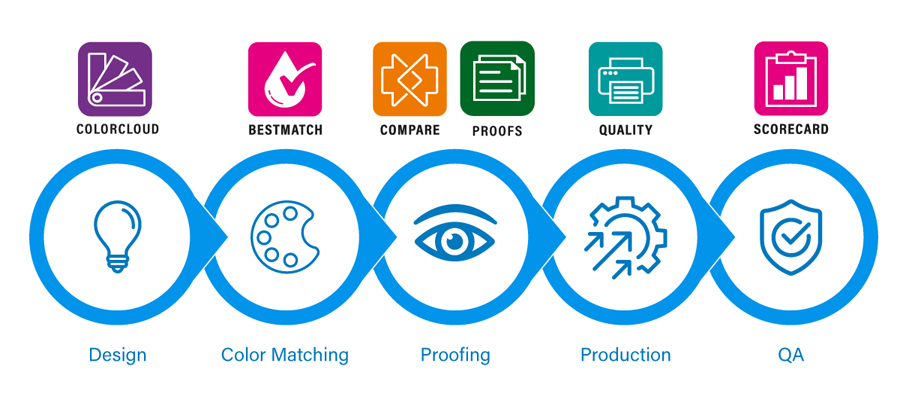
INX Color Perfection® is an enterprise color management platform that connects color data, quality assurance, and digital proofing—ensuring global color consistency from design through production.
The Future State of Spot Color Management
Spot color challenges persist not because the industry lacks measurement capability, expertise, or intent—but because the underlying model for communicating color intent has not kept pace with production reality.
Spectral data transforms spot color into a digital, spectral asset. Digital proofing enables that asset to be evaluated predictively rather than visually. INXCloud ensures it is governed, shared, and executed consistently across the value chain.
Together, they represent a necessary evolution in brand color management—one aligned with modern packaging complexity, distributed manufacturing, and the expectation that color outcomes are predictable by design, not corrected by exception.
Share